
Meet George Jetson: Why Jim Carrey Might Be Exactly What The Jetsons Needs
Meet George Jetson: Why Jim Carrey Might Be Exactly What The Jetsons Needs
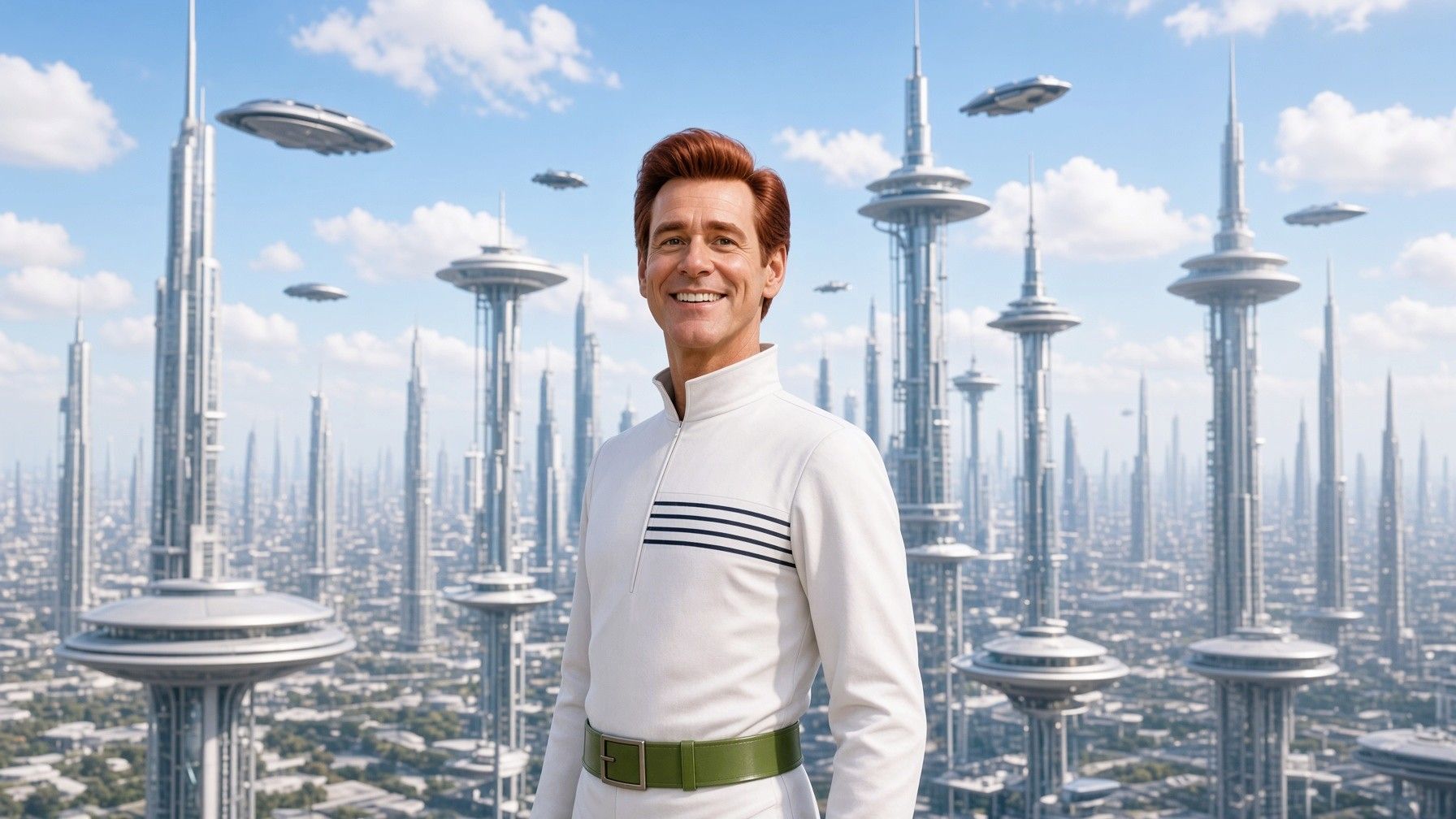
Hollywood has been promising us the future for decades. The Jetsons got there first. More than sixty years after Hanna-Barbera sent an ordinary suburban family into the skies above Orbit City, Warner Bros. is preparing to bring them down to Earth in live action. And with Jim Carrey stepping into George Jetson's futuristic shoes, one of animation's most recognisable families may finally have found the wonderfully unpredictable ingredient needed to make tomorrow feel exciting again.
Meet George Jetson. His boy Elroy. Daughter Judy. Jane, his wife.
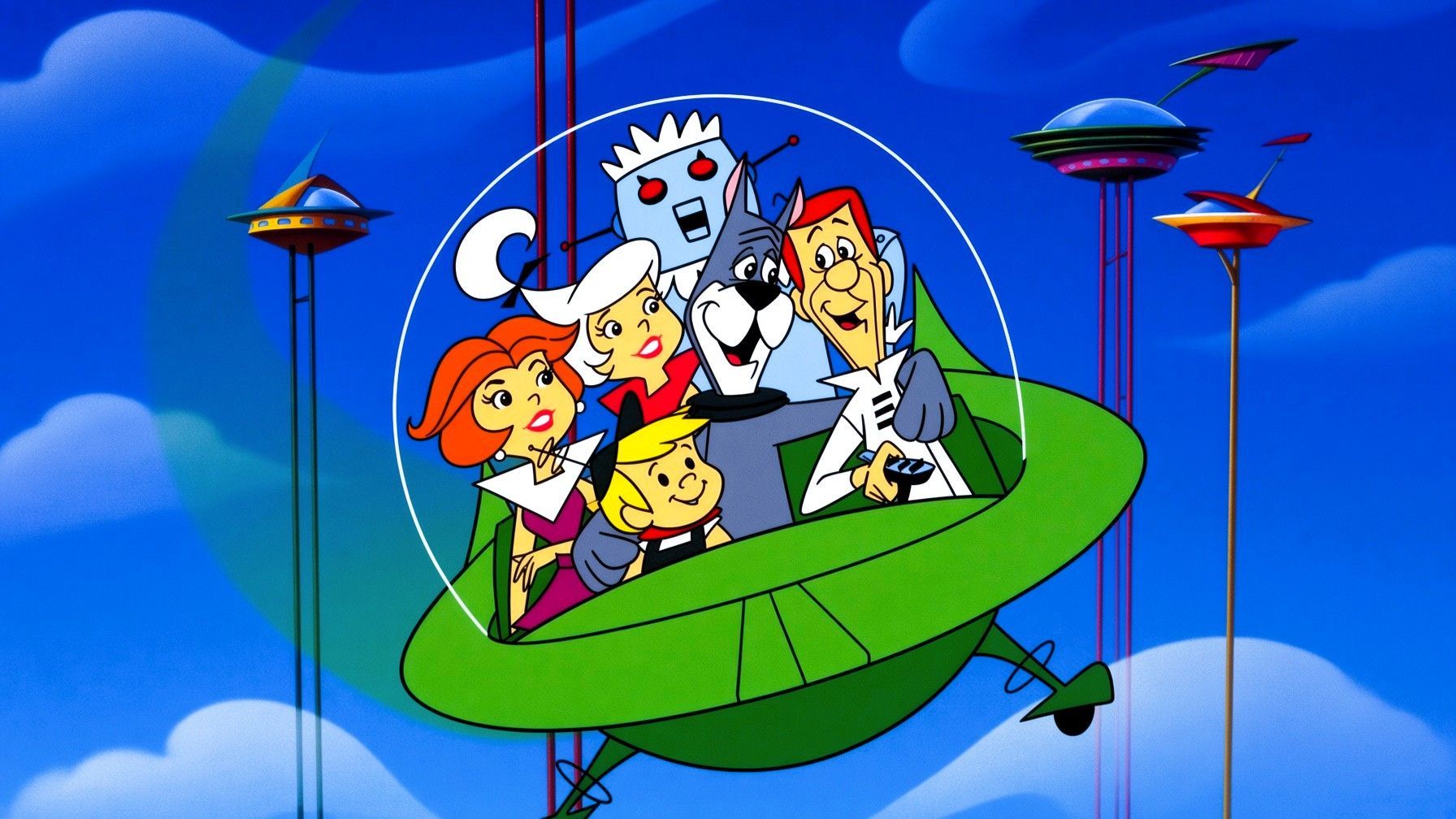
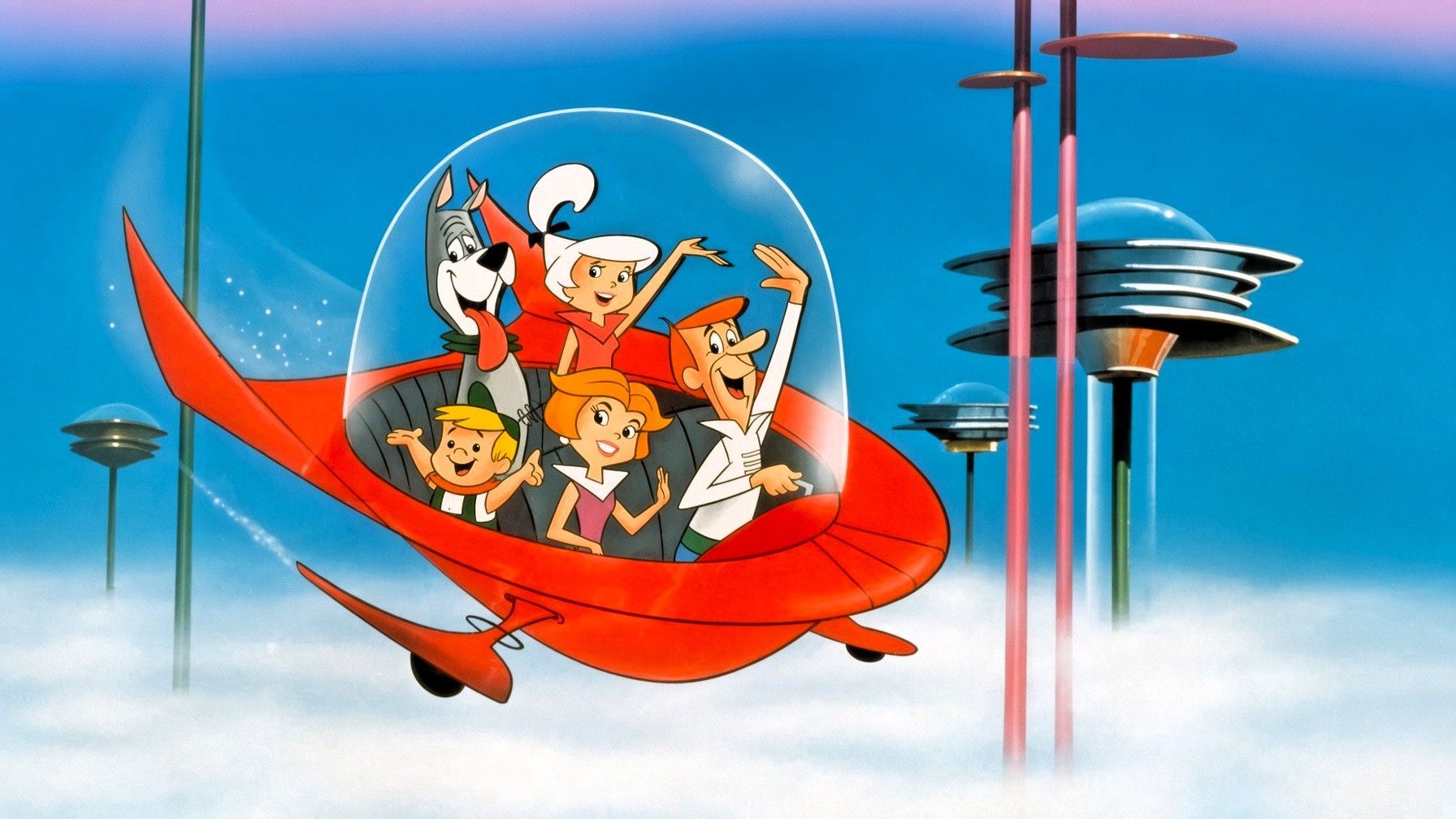
For more than sixty years, those names have belonged to one of popular culture’s most enduring visions of tomorrow. A place of bubble-domed apartments, moving pavements, robot housekeepers and flying cars, where the average family could live among the clouds and still somehow spend most of the week complaining about work.
Now Hollywood is preparing to introduce the Jetsons all over again. And George Jetson has acquired a rather familiar face.
Jim Carrey is officially attached to star in Warner Bros.’ forthcoming live-action The Jetsons, placing one of the most physically expressive performers of his generation inside a world originally designed according to the limitless possibilities of animation.
Warner Bros. Discovery included the project among films planned beyond 2027 in its August 2026 communication to shareholders.
It is an intriguing combination. Carrey has spent the last few years behaving increasingly like a man who no longer needs Hollywood very much. The Jetsons, meanwhile, has spent considerably longer behaving like a property Hollywood cannot quite work out how to make.
Perhaps they have finally found each other at exactly the right moment.
The Jetsons Are Finally Coming to Life
What Warner Bros. has revealed already gives us a surprisingly clear idea of where this new version of The Jetsons might be heading.
Jim Carrey will star in the studio's live-action adaptation, with the project currently sitting somewhere beyond 2027 on Warner Bros.' calendar. That gives the filmmakers something unusually valuable: time. Time to work out what Orbit City should look like in a world that has already caught up with so many of its inventions, and time to decide what George Jetson should represent more than sixty years after audiences first met him.
Carrey, then, is the first major piece of this new Orbit City to fall into place.
The rest requires a little more caution.
When the project first surfaced in October 2025, Carrey was still reported to be negotiating to star. Colin Trevorrow, director of Jurassic World and Jurassic World Dominion, was in talks to direct, while Trevorrow and Joe Epstein were negotiating to write the screenplay. At that point, Warner Bros. offered no plot details and declined to comment on the reporting.
Carrey's involvement has since moved from negotiation to confirmation. Precisely how much of that earlier creative configuration survives should be treated more carefully until Warner provides a fuller announcement.
As yet there is no confirmed Jane. No Judy or Elroy. No Mr Spacely, Rosie or Astro. But there is a George Jetson.
And Warner has chosen somebody who, only a few years ago, appeared perfectly happy never to lead another major movie again.
Jim Carrey Was Supposed to Be Retired
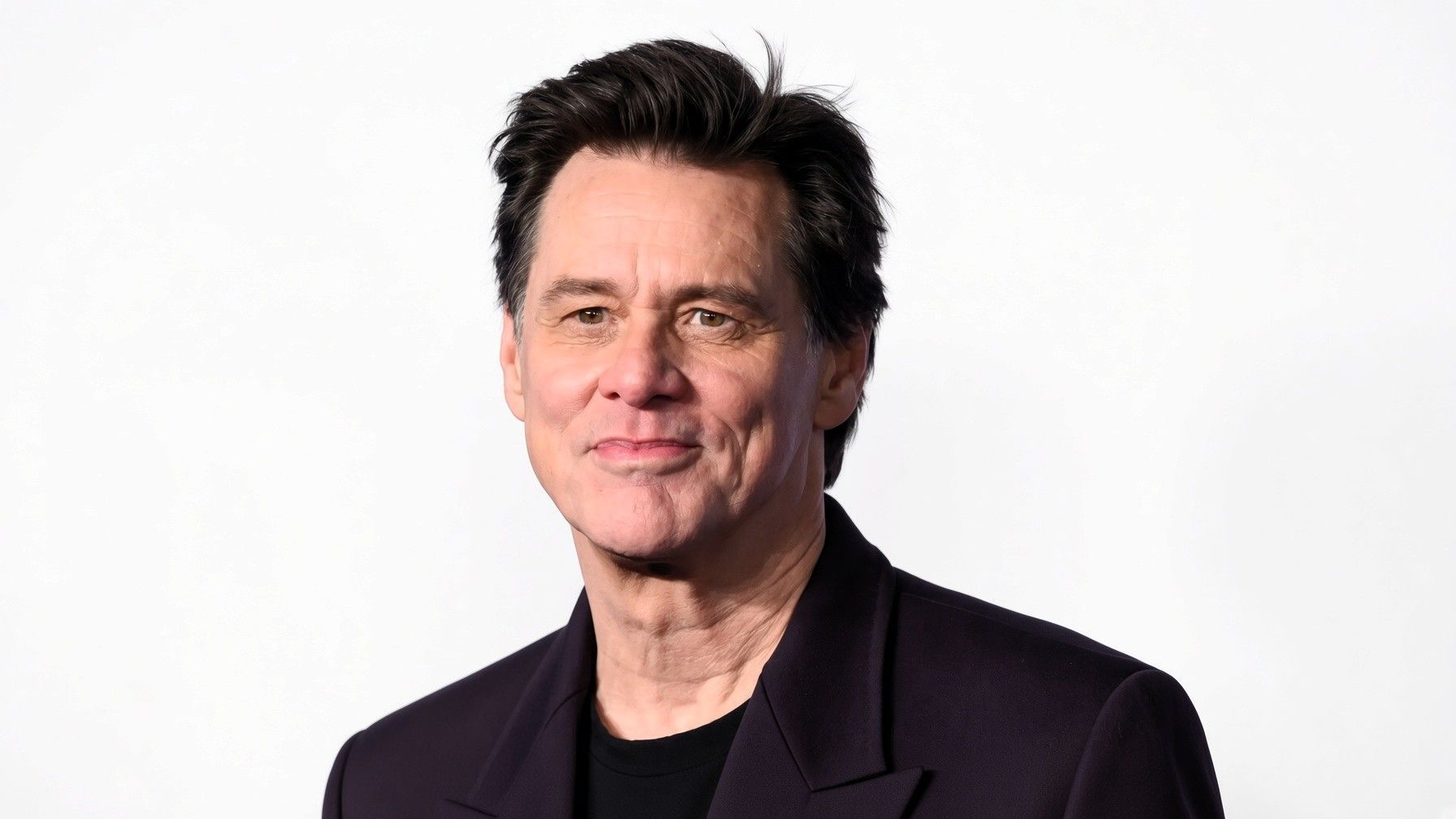
Carrey's relationship with retirement has been slightly less definitive than the word itself might suggest.
While promoting Sonic the Hedgehog 2 in 2022, he said he was "fairly serious" about stepping away from acting. He had reached a point where painting, spirituality and a quieter life seemed more attractive than another production schedule. It would, he joked, take something resembling a script delivered by angels and written in gold ink to change his mind. Then Dr Robotnik came calling again.
Carrey returned for Sonic the Hedgehog 3, later acknowledging that his retirement declaration had been somewhat hyperbolic. His explanation for returning was delivered with characteristic mischief, including the memorable admission that he had bought rather a lot of things and needed the money. The joke shouldn't obscure the more interesting point though. Carrey doesn't work anything like the way he once did.
This is an actor who, at his commercial peak, could release Ace Ventura: Pet Detective, The Mask and Dumb and Dumber in the same year. Modern Carrey is considerably harder to coax onto a film set. The Sonic movies gave him an enormous comic playground in Robotnik, but outside that franchise his appearances have become increasingly selective. Which makes George Jetson worth paying attention to.
Whatever was in this particular script, pitch or idea, somebody persuaded Jim Carrey that Orbit City was worth a visit.
Actually, Jim Carrey Makes a Strange Amount of Sense
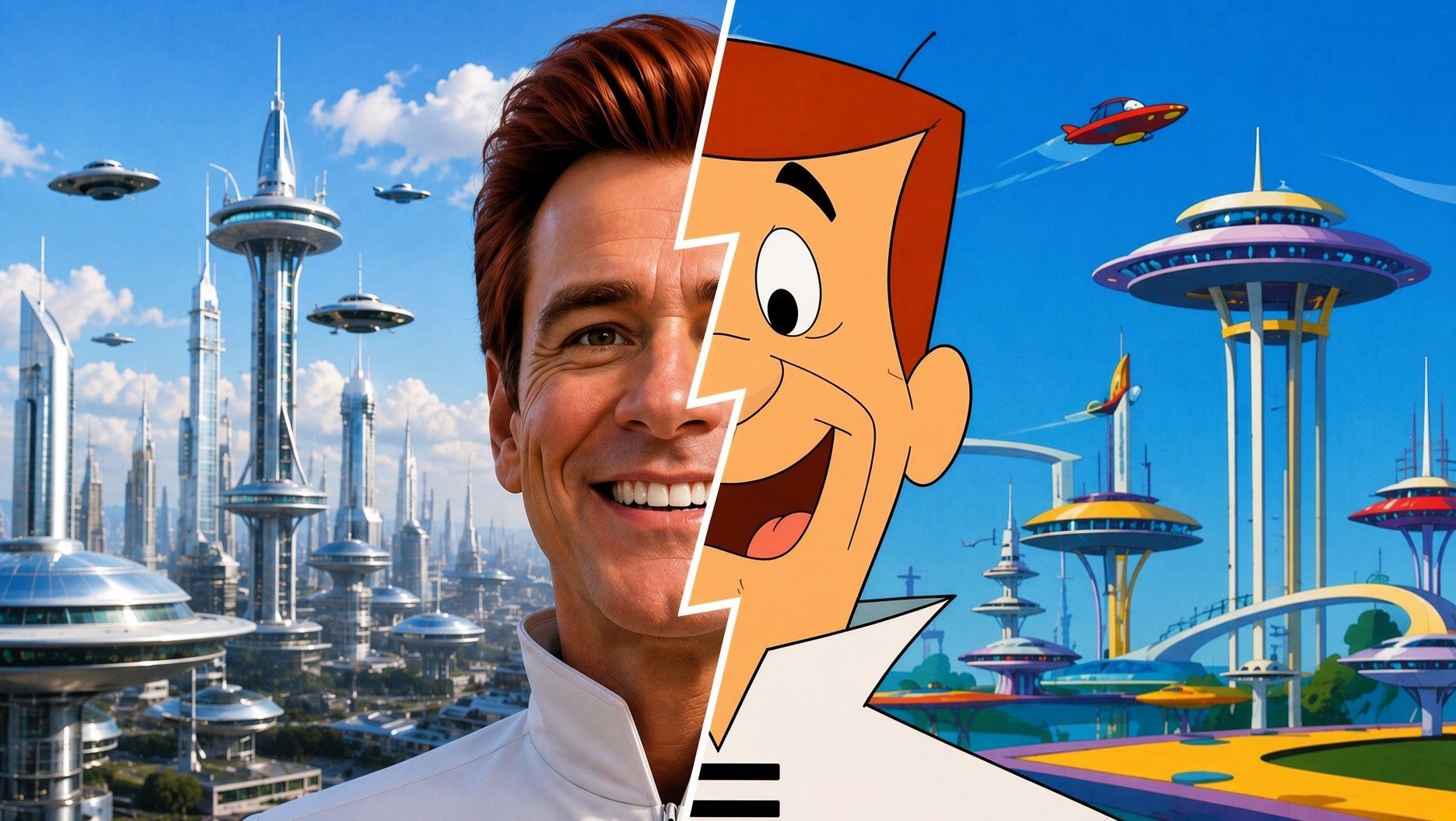
Casting Jim Carrey as George Jetson comes with a certain amount of baggage.
George's eyes bulge. His arms flail. A household gadget malfunctions. Rosie crashes through a wall. Mr Spacely screams at him. George ends up trapped on a treadmill shouting, "Jane! Stop this crazy thing!" …and there is probably room for some of that.
But it would also miss what makes the casting interesting.
George Jetson isn't really an anarchic character. He is an ordinary man living in an extraordinary world. He has a wife, two children, a dog, a mortgage-shaped existence and a boss who seems capable of firing him before breakfast and rehiring him by lunch.
The comedy comes from the contradiction. Technology has supposedly eliminated life's inconveniences, yet George remains permanently exhausted by them.
That is where the older Carrey becomes considerably more interesting than simply casting one of cinema's great physical comedians in a cartoon adaptation. The frantic energy was always only part of his talent.
The Truman Show understood the sadness sitting underneath that enormous smile. Eternal Sunshine of the Spotless Mind stripped away much of the performer's armour altogether. Showtime's Kidding found something even stranger in middle-aged Carrey, allowing sweetness, grief and barely contained instability to occupy the same face.
Even Robotnik has evolved into something more precise than a simple return to 1990s excess. Carrey still knows exactly when to explode, but he also understands the value of holding still before he does. George could use both versions.
There is something inherently funny about putting Jim Carrey inside the body of a suburban father who lives in a flying apartment, commutes in a spacecraft and still dreads Monday morning.
There might even be something unexpectedly poignant about it.
Hollywood Has Been Trying to Build Orbit City for Decades
Nobody should mistake this for Hollywood suddenly discovering The Jetsons. The industry has been trying to get George's flying car out of the garage for years.
A live-action incarnation was being developed with Adam Shankman in the early 2000s. Robert Rodriguez later became associated with a CGI version. Neither reached cinemas. Warner subsequently shifted towards animation, eventually hiring Sausage Party co-director Conrad Vernon to develop an animated feature in 2017. Vernon later stepped away as director while remaining involved as a consultant.
That same year produced another attempt.
ABC gave a put-pilot commitment to a live-action Jetsons sitcom, written by Gary Janetti and executive produced by Robert Zemeckis and Jack Rapke. The concept was elegantly simple: America's favourite future family, still living 100 years ahead of us, viewed through a modern lens.
Again, Orbit City remained tantalisingly out of reach.
The irony is that the longer Hollywood has taken to make a modern Jetsons, the more interesting the problem has become; because while George Jetson has been waiting for his live-action debut, the rest of us have been steadily catching up with him…
The Future The Jetsons Predicted Is Already Here
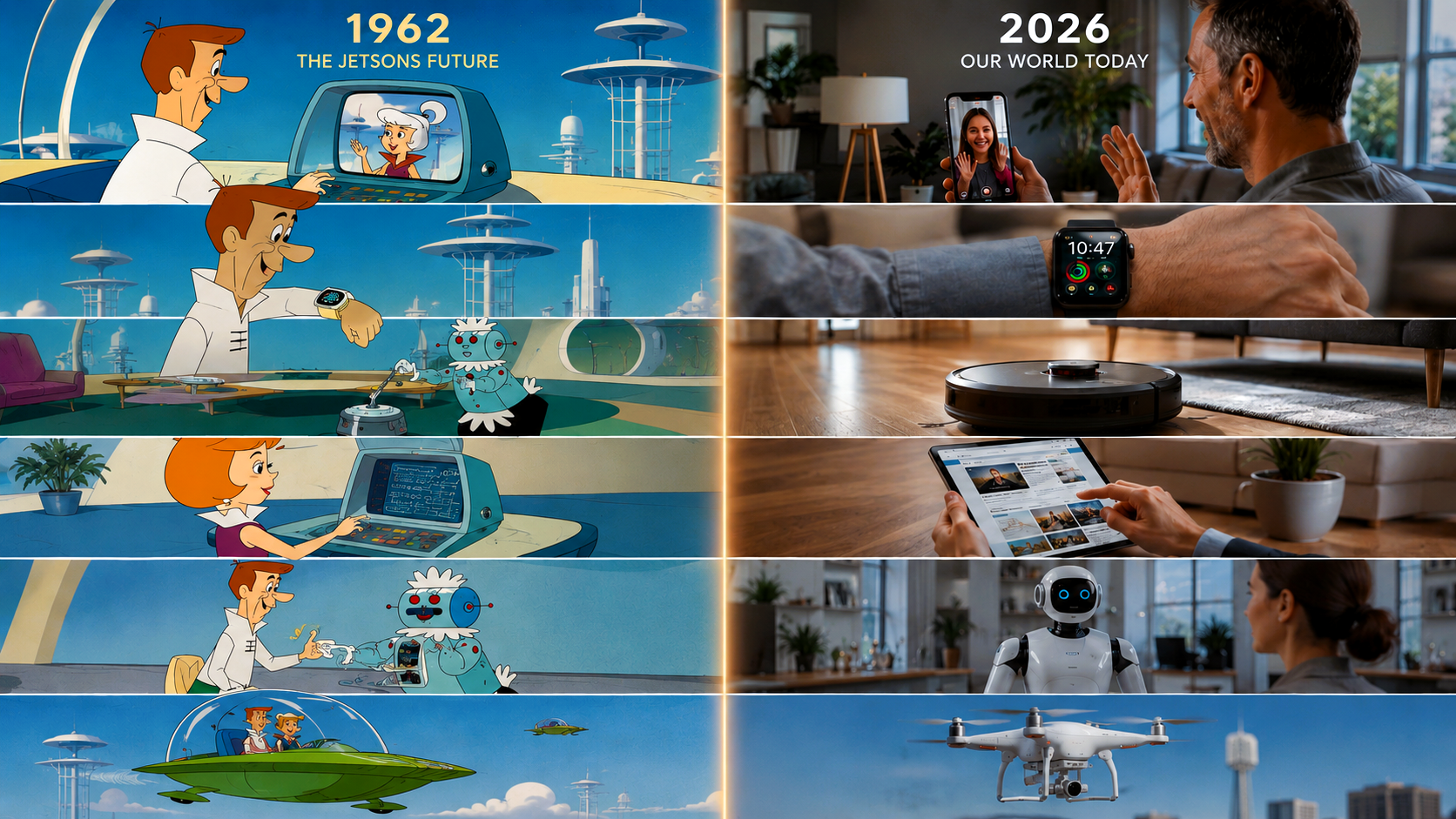
When The Jetsons premiered on ABC in September 1962, its future was an intoxicating cocktail of Space Age optimism and suburban familiarity.
America had watched John Glenn orbit the Earth only months earlier. The space race was accelerating. Tomorrow seemed simultaneously exhilarating and terrifying.
Hanna-Barbera took that mood and gave it a family.
George still went to work. Jane still ran the household. Judy worried about boys. Elroy went to school, and the dog caused trouble. They simply did all of it several miles above the ground.
What remains extraordinary is how much of that technological wallpaper no longer looks particularly futuristic. Video calls are the norm, flat-screen televisions are everywhere, tablets have become children's toys and smartwatches now sit on millions of wrists worldwide. And before you say it, yes, robot vacuum cleaners exist, and you could probably have one delivered to your door this afternoon. As for drones, they're hardly science fiction anymore. You can pick one up almost anywhere.
Much of what once helped make Orbit City look like tomorrow has quietly become part of everyday life.
The Smithsonian's National Museum of American History specifically identifies video calling, tablets, robotic vacuums, smartwatches, flat-screen televisions, drones and holograms among technologies imagined by The Jetsons that subsequently became real or recognisable parts of modern life.
Rosie still has some catching up to do… So do the flying cars. And, disappointingly, nobody appears particularly close to constructing entire cities on enormous pillars in the sky.
Yet The Jetsons achieved something more important than accurately predicting tomorrow’s gadgets. It gave popular culture a visual vocabulary for the future.
Smithsonian has described the original 24-episode 1962-63 season as one of the defining pieces of 20th-century futurism. For decades afterwards, whenever some new technology appeared, comparisons with The Jetsons inevitably followed.
That creates a wonderful problem for the new movie.
How do you make the future look futuristic when your audience is already carrying half of it in their pocket?
How Do You Make The Jetsons Futuristic in 2028?
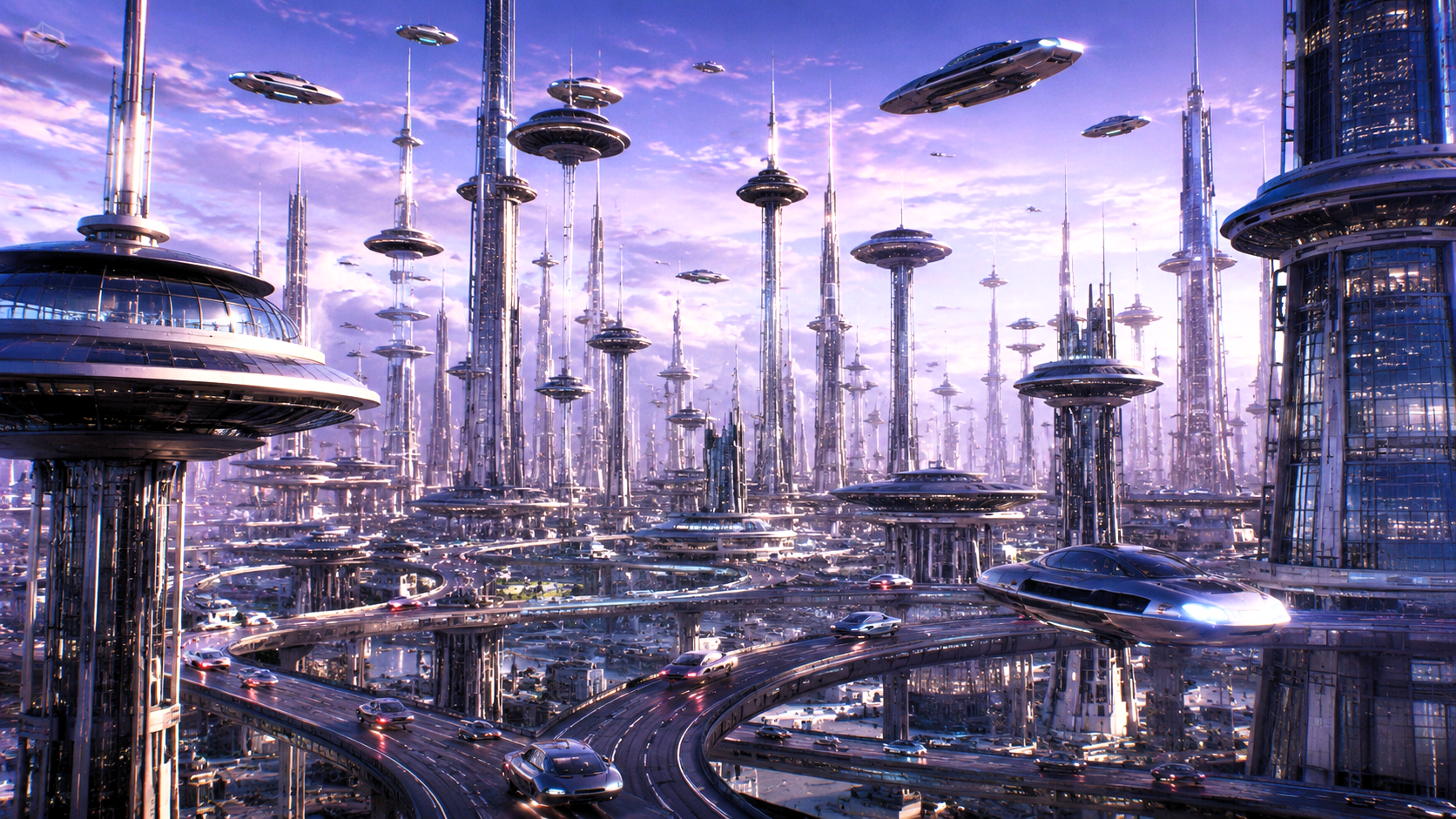
This may ultimately be the most important creative decision anybody makes. Imagine designing Orbit City today.
Putting George on a video call won't do it. Having Jane speak to a computer won't do it. Giving Judy a screen she can carry around certainly won't do it.
Artificial intelligence can already generate images, answer questions, write software and imitate human voices. Cars can drive themselves under certain conditions. Billionaires launch reusable rockets into space. A humanoid domestic robot no longer belongs entirely to fantasy. The goalposts have moved.
One solution would be to chase contemporary technological credibility and reinvent The Jetsons as a sleek vision of what might actually exist several generations from now.
That would also be an excellent way of losing much of what makes The Jetsons look like The Jetsons.
Orbit City has a visual language.
The original series borrowed heavily from the Googie architecture surrounding Hanna-Barbera's artists in Southern California: sweeping curves, dramatic angles, glass, steel and the exuberant optimism of postwar Space Age design. Buildings such as Los Angeles International Airport's Theme Building and John Lautner's Chemosphere already looked as though somebody had dropped them out of George Jetson's neighbourhood.
A smart adaptation shouldn't be embarrassed by that. It should lean into it. Let Orbit City look like 1962's dream of 2062, polished through the visual possibilities of modern filmmaking. It’s better than the one we have! I’ve always loved the science fiction art of the ’50s, ’60s and ’70s, which so often depicted a glass-half-full vision of the future, where humanity had harnessed technology to create something approaching an idyllic utopia.
The tension between retro-futurism and genuine futurism could become part of the pleasure. There is no reason George's flying car needs to resemble something Tesla might unveil next year. It should look like a flying car imagined by somebody who thought tomorrow would arrive with tailfins.
Because underneath all that chrome, glass and anti-gravity, The Jetsons was never particularly interested in predicting technology anyway.
The Jetsons Was Never Really About Technology
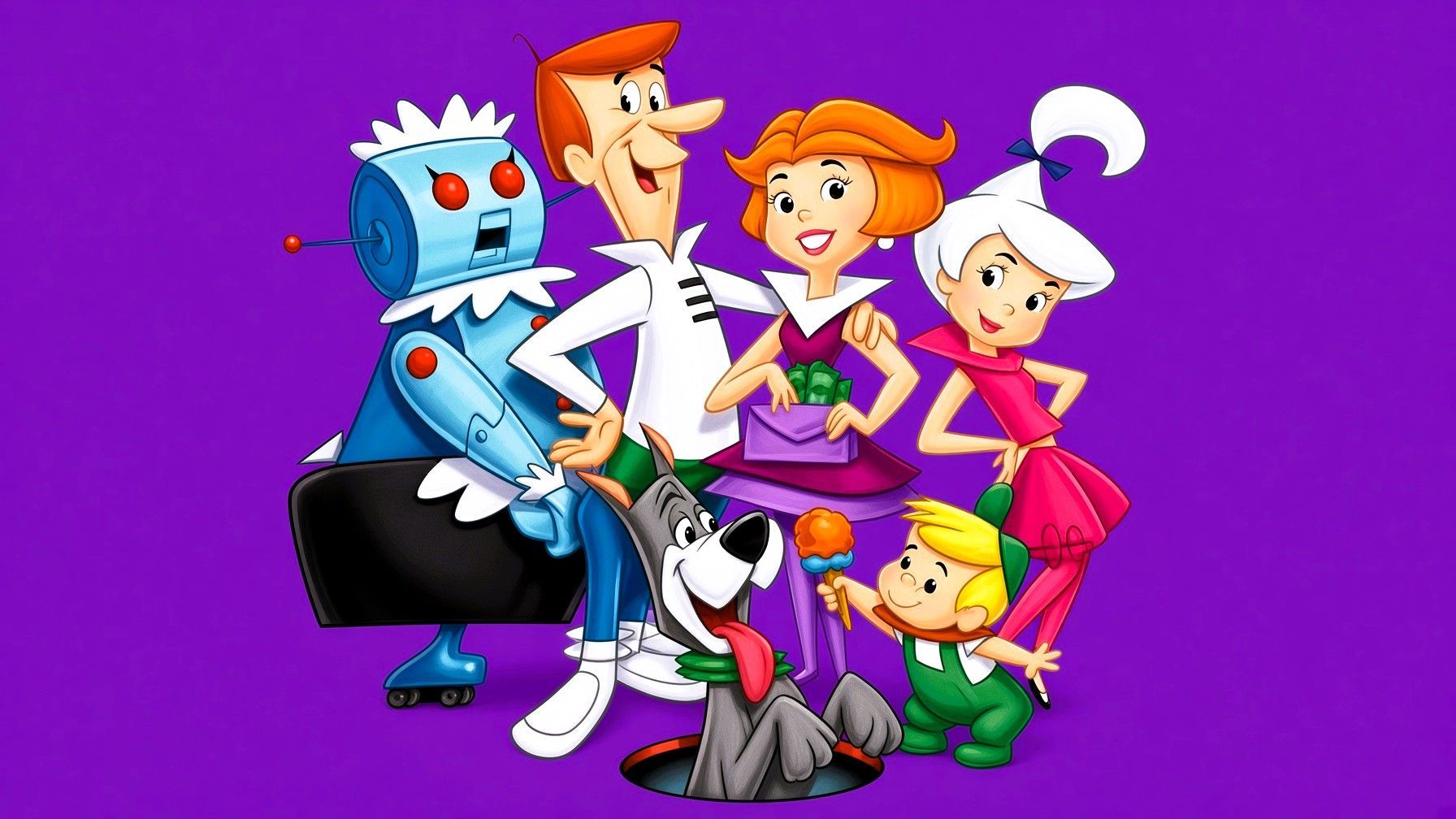
Strip away the flying cars and the robot maid and something surprisingly conventional remains: a family sitcom.
The Smithsonian makes precisely that observation about the original programme. Despite all its futuristic gadgetry, the Jetsons dealt with many of the same concerns as the television families surrounding them: work, children, neighbours, money and domestic life.
George's world had supposedly conquered inconvenience, yet he was still stressed. That joke might be funnier now than it was in 1962.
Technology has spent decades promising to give us our time back. Email was faster than letters. Smartphones put everything in one place. Remote working removed the commute. Automation eliminated repetitive jobs. Artificial intelligence now promises to take another enormous bite out of the mundane. Yet somehow, the more technology promises to simplify our lives, the more complicated our relationship with it seems to become.
What happens to George Jetson when AI can perform half his job? What does Mr Spacely expect from an employee whose working day has been automated almost out of existence? What does family life look like when every appliance is intelligent, every surface is connected and convenience has become impossible to escape?
Suddenly the sixty-four-year-old sitcom has teeth again.
A successful movie doesn't need to turn The Jetsons into Black Mirror. That would be equally misguided. There is warmth in this property, along with silliness and an almost infectious optimism about tomorrow. The trick will be finding something contemporary to say without sacrificing any of it.
The best family films understand that children and adults can laugh at the same thing for completely different reasons. George fighting with an intelligent household appliance can be slapstick. George discovering that the appliance understands his job better than he does can be satire.
Jim Carrey is unusually well equipped to do both.
And perhaps that's where the possibilities of this new version become most interesting. The future imagined in 1962 cannot mean the same thing in 2028. Some of its wildest inventions have become mundane. Others remain wonderfully ridiculous. The society underneath them looks increasingly like a historical artefact, while its central joke about technology making life easier, only for human beings to discover entirely new things to worry about, feels remarkably intact.
That makes revisiting Orbit City more than an exercise in recognition. And Jim Carrey is a fascinating man to put at its centre.
He can still bend his body around a malfunctioning machine. He can still turn a facial expression into a punchline. But he can also play weariness, tenderness, frustration and the quiet suspicion that the supposedly perfect world surrounding you isn't making you quite as happy as advertised. George Jetson may require all of it.
More than six decades after Hanna-Barbera introduced audiences to the family of the future, Hollywood is finally preparing to meet George Jetson in the flesh.
The future has changed enormously since George Jetson first flew across our television screens. The exciting part is discovering whether Orbit City can make us dream about it all over again.
This feature is based on information cross-referenced from Warner Bros. Discovery announcements and reputable sources including Variety, People, the Los Angeles Times, The Guardian and the Smithsonian. Historical details concerning The Jetsons, its previous development attempts, Space Age influences and technological predictions were checked against industry reporting and Smithsonian archive material. Jim Carrey's comments on retirement and his return for Sonic the Hedgehog 3 were sourced from published interviews and contemporary reporting. Unconfirmed details have been identified as reported or speculative. Analysis and commentary are original to Ninth Planet.